Crisarium
Start the simulation

Plan for organizations

See how your leadership team decides in a cyber crisis — before the attack.

Up to 10 executives, each in their own role, face a cyber crisis, round by round. At the end, a report shows where each function's right decisions collided, what that would cost and whether the crisis plan was followed.

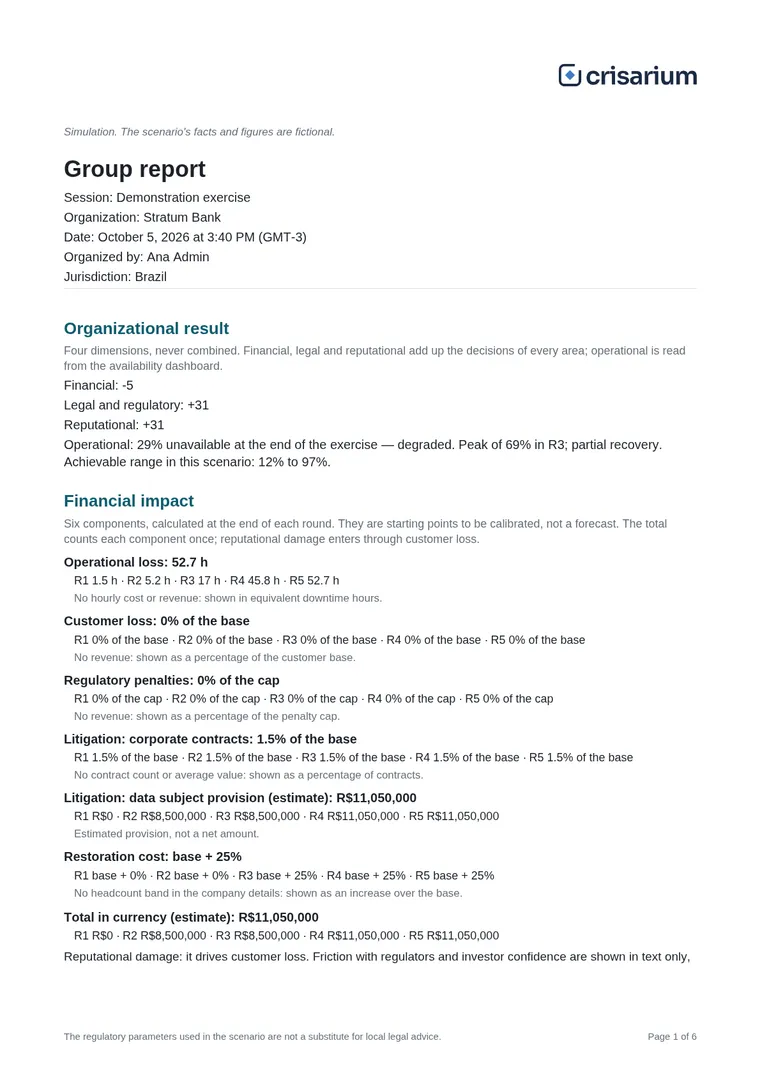
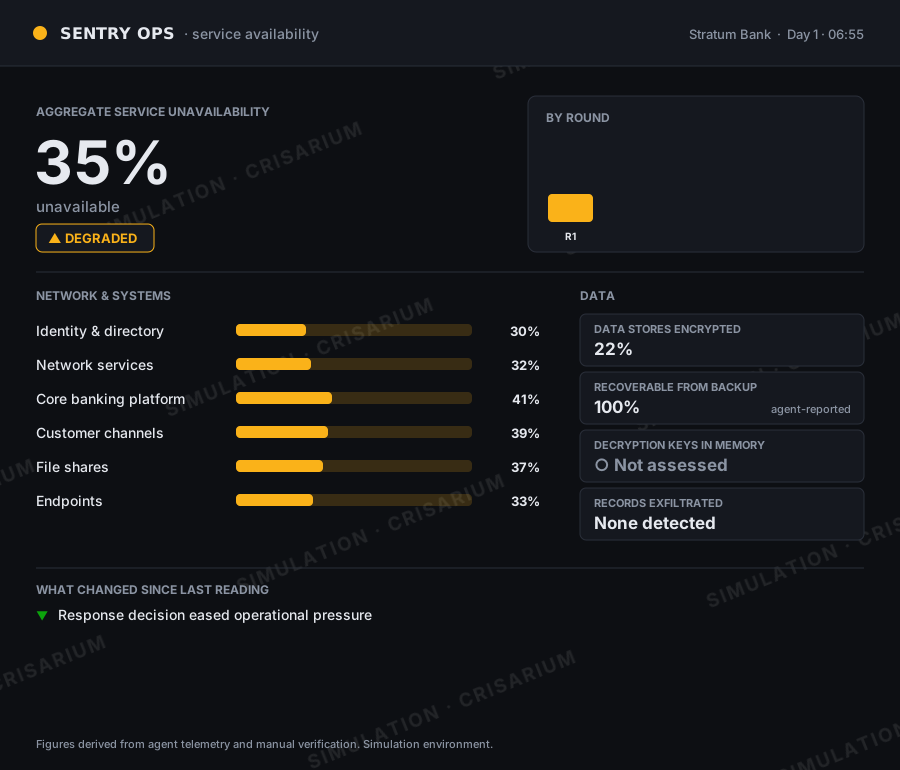
Cover of the group reportSystems availability panel in the simulation
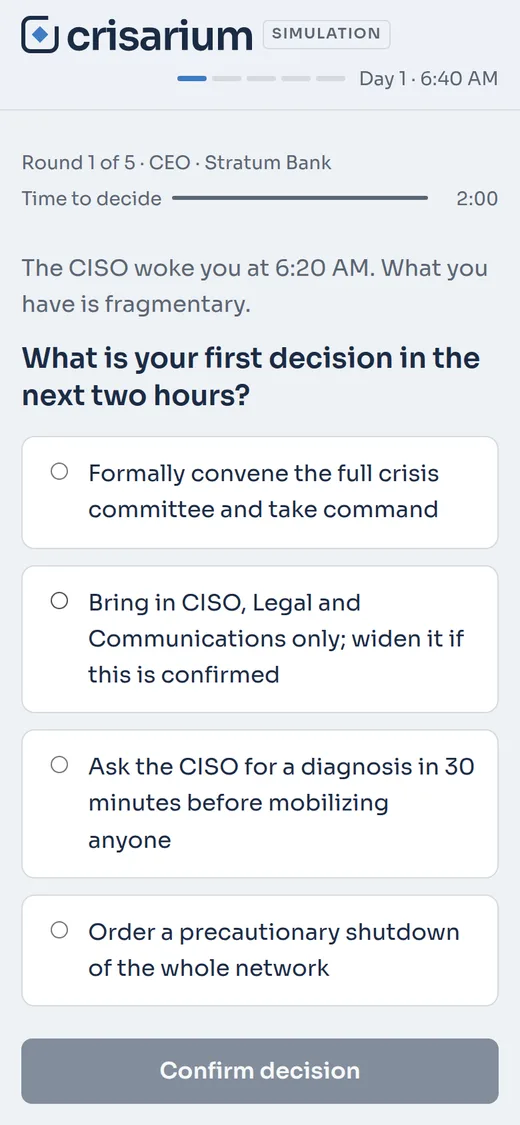
Simulation decision screen on a phone
  • 5 rounds, one full incident — from detection to accountability before the Board / Shareholders.
  • Up to 10 roles — CEO, CFO, Compliance/DPO, Communications, CISO, IT, Operations, Legal, Customer Service and Investor Relations.
  • No meeting required — each executive decides on a phone or computer, at their own pace.

How it works

  1. 1

    You set the scenario, the jurisdiction (Brazil, European Union, United States or International), the roles and a 24- or 48-hour window for each round.

  2. 2

    Each executive gets a personal link and decides in their own role, under the same pressure and deadlines they would face in a real crisis.

  3. 3

    After each round, the committee sees everyone's decisions. Roles without a person are decided by AI; anyone who doesn't respond is on record.

  4. 4

    The Board / Shareholders hold the team to account for its decisions, and you receive the individual, group and financial impact reports.

Where each function's right decisions collide

Every executive can get their own role right and the company can still end up worse off. The report shows the contradictions between functions — what no individual exercise reveals.

CEO

Refused any contact with the criminals.

Divergence
CFO

Set aside funds for the ransom payment.

the contact center denied the leak while Communications was acknowledging it · IT restored before Cybersecurity's criteria were met.

What your organization gets

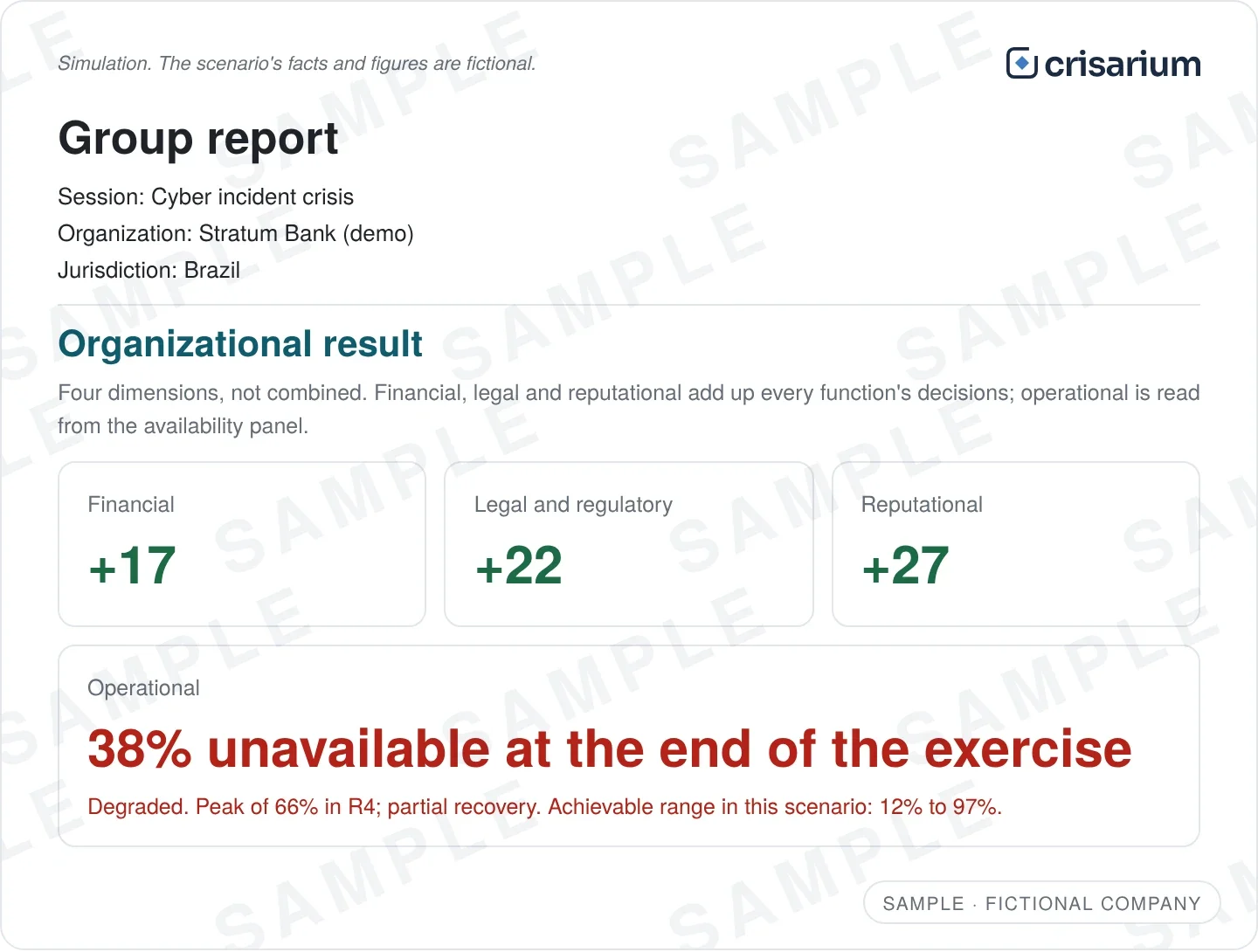
Excerpt from the sample report: Results in four dimensions

Individual and group reports, as PDFs. For each executive: the decisions, response time and how much of the best achievable outcome in their role they captured. For the organization: where functions diverged, the timeline, each function's response time and absences.

SIMULATIONR1R2R3R4R5$1M$17M

Financial impact round by round. Fines, customer loss, restoration cost, litigation and operational downtime — showing which decision made the exposure spike.

What the plan doesn't cover

  • Attacker contact and ransom decisionhigh severity
  • Notification to the data protection authorityhigh severity
  • Internal communicationmoderate severity
  • Cost quantification and close-outlow severity

Adherence to your crisis plan. You upload the plan, review the rules extracted from it, and the exercise measures whether decisions followed what it sets out. Topics the plan doesn't cover show up as gaps. The file is discarded right after it is read.

The decision to pay · 5 minutes

This is the point where internal pressure is highest and the time to think is shortest. It helps to separate what is true from what seems true.

Training where decisions cost the most. Short modules, selected from each executive's performance, covering what the rules require and how to decide better.

Scenarios

Available now

Ransomware with a data leak. Systems go down on a weekday morning, and the group demands a ransom and threatens to publish customer data. The leadership team decides on containment, the regulator, the press, customers and the payment — with information that changes every round.

Critical vendor down. The provider that runs payments and customer service stops responding, with no time to recovery and no word on whether data was accessed. Operations depend on a third party that won't answer: when to trigger the contingency plan, what to tell customers without knowing the cause, what the contract guarantees and whether it's time to switch vendors.

CEO deepfake fraud. A video and a call in the CEO's voice authorize an urgent transfer; the money is gone before anyone notices. Hours to try to recover the funds, the question of who is accountable, insurance that may not cover social engineering and a review of payment approval limits.

Data leak without ransomware. A journalist reports that customer data is for sale on a forum. Nothing is down, no one has asked for a ransom, and the source is unclear: a vendor or an insider. The regulatory clock runs from the awareness date, customers become targets for scams and the internal investigation has employment-law limits.

Coming soon, in the annual plan

Coming soon

Manipulated AI assistant. The virtual assistant that serves customers is tricked by instructions hidden in ordinary messages: it starts showing other customers' data and approving refunds no one authorized, and screenshots spread on social media. Shutting down a channel that serves thousands a day, what to say without knowing the scope, how much the model vendor is liable for, the regulator and the limit on what AI may do without a human.

Coming soon

Breach through a vendor's access. An IT service provider with remote access to the company's systems is compromised, and the criminals get in with its credentials. To monitoring, it looks like the vendor's routine work — until money and data start to leave. Cutting off access operations depend on, how far to trust what the vendor reports, how many of its other clients were hit, who bears the loss and what to tell the regulator and customers.

Plans and pricing

Single exercise

US$ 690

1 exercise

  • Individual and group reports
  • Financial impact
  • Adherence to your crisis plan
  • Tailored training
  • Administrator dashboard
  • Your company's name in the scenario
Buy

Annual plan

Best cost per exercise

US$ 2,390 per year

4 exercises · US$ 598 per exercise · save US$ 370 vs. four single exercises

  • Everything in the single exercise
  • 4 exercises in 12 months
  • New scenarios throughout the year
  • Comparison across exercises
Buy

Pix or boleto with an invoice in Brazil; clients outside Brazil pay by card or bank transfer. Activation within 2 business days after payment. 30-day guarantee: cancel before the first session and we refund the full amount.

A facilitated tabletop exercise costs tens of thousands of dollars and takes the leadership team's whole day. The annual plan costs less than a single session like that.

Security

  • Each organization's data isolated and encrypted
  • Mandatory second factor for administrators
  • Crisis plan read and discarded, never stored
  • Our team doesn't see responses without your authorization

Frequently asked questions

Does everyone need to meet at the same time?

No. Each round stays open for 24 or 48 hours, and each executive decides when they can, on a phone or computer.

How much time does each executive spend?

A few minutes per round. There are five rounds.

What if someone doesn't respond?

AI decides for the role, and the absence is recorded in the report.

Can we use our company's name?

Yes. The scenario uses your organization's name in every text and screen, always with the simulation watermark.

How does payment work?

In Brazil, Pix or boleto, with an invoice (nota fiscal) from Segurança em Jogo. Outside Brazil, card or bank transfer, with an invoice.

What if it doesn't work out?

Cancel before the first session, within 30 days, and we refund the full amount.

See how your leadership team decides before an attack shows you.

Plan for organizations · Crisarium